

| by Russell Bulgin (AutoWeek Sept. 18, 2000)
Jack Daniels walks slowly around the new Mini, checks it from all angles, climbs in. He is, he explains matter-of-factly, now "eighty-eight-and-a-half years old," long retired. As chief designer and development engineer for the original Mini, he worked at Sir Alec Issigonis' right hand. Jack refers to his late boss as "Izzy." "He and I jelled," he says of Issigonis. "That's the only word you can use. He would accept virtually anything that I said. If I said 'You've got to alter it' he would say 'Alter it...' When he sketched things out, his sketches were very good indeed, you could follow them pretty well. In the end, if the suspension geometry needed to be moved, I'd move it. I didn't go back and tell him. I just did it. To be quite honest, I knew more about suspensions than he did, anyway." What would Izzy make of the new Mini? "He would be dead against giving space away in the back of the thing there," says Daniels. "There's basically room for some people there-but you'd have a hell of a job to get them there." And the engineer's first impressions of the new Mini? "Very, very pleasant indeed," says Daniels in his quite farmers voice. "An excelent attempt. If they were trying to make the Mini they've done better than anyone else who has tried so far. Size-wise, they know what they want: I don't know what they want these days..." BMW's take on the Mini is to focus on two particular strands of the car's 41-year history: thrice winning the Monte Carlo Rally and the cult British movie The Italian Job, in which Micheal Caine and a gang of English villains rob Fiat's payroll in Turin, cheekily escaping through the city's sewers in one red, one white and one blue Mini Cooper S. "None of those things were in Izzy's mind at all," smiles Daniels. Because Issigonis, Daniels and suspension guru Alex Moulton were pragmatists above all, fired by eking space for four occupants in a car 10-feet long. They rationalized the small car "We saw the car as something which, very largely, would attract a lot of women drivers. Or leaner drivers. We tried desperately for safety on that car, working with Dunlop (on tires and suspension)." The new car is painstakingly styled. Issigonis, assisted by John Shepherd, simply shaped Mini from the inside out." At the time, Farina was working in the factory on the Austin A40," recalls Daniels. "This was at the point when nobody could make any changes to what we were doing. Farina was taken in and shown one Mini. Izzy was there. In the end, Izzy says, 'What ought I to do to it, Sergio?' 'Do?' says Farina. 'Don't touch it. It's unique'." Mini was the world's first successful transverse-engined front-drive car. "The Ford Model T was the car that started mass production," says Daniels firmly. "But the Mini was the first car to change cars, and change them for the better. That's my personal opinion." With tiny 10-inch wheels, innovative rubber cone suspension and an unforced air of cheeky functionality, Mini proved that for Daniels, Izzy and Alex Moulton, rules were always there to be broken. "The engine didn't give us much trouble at all, really," he explains. "The gearbox: I did the first bugger anyway, got it cast quietly. The 10-inch wheel was the basis of the trouble. We'd got to get decent brakes in there. Fitting seven-inch (drum) brakes in a 10-inch wheel was not easy-the first thing that happens is (to ask) 'How do we shed the water out of the drum?'" Daniel's job was huge. "Draw the bloody thing. Do all the initial testing. All the pre-development with rigs and what-have-you. There's no way you could do it today. It isn't on anymore. Quite frankly, I think I enjoyed the best of the motor industry," he says quietly, thinking over a career that began at MG in 1927. "We did the Mini in two years and one month. With no computers..." " |
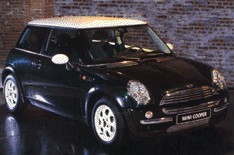 "Well, well, well..." says Jack
Daniels with a faint air of bemusement. "They've done bloody well. I'll
give them due credit for that. Everybody's tried it and haven't got anywhere
near it. Well, well, well...."
"Well, well, well..." says Jack
Daniels with a faint air of bemusement. "They've done bloody well. I'll
give them due credit for that. Everybody's tried it and haven't got anywhere
near it. Well, well, well...."